

Choosing Shaka Wear Blank T-Shirts for Custom Printing in NYC
Choosing a blank T-shirt may seem like the simplest part of creating custom apparel, but it can influence almost everything that comes afterward. The weight of the fabric affects how the shirt hangs. The fit changes how the finished design looks when worn. The surface of the material can influence the appearance of printed artwork, while color and construction affect the overall character of the final piece.
For designers, clothing labels, print shops, event organizers, businesses, and creative teams in New York City, the right blank should therefore be chosen around the finished product, not simply around price.
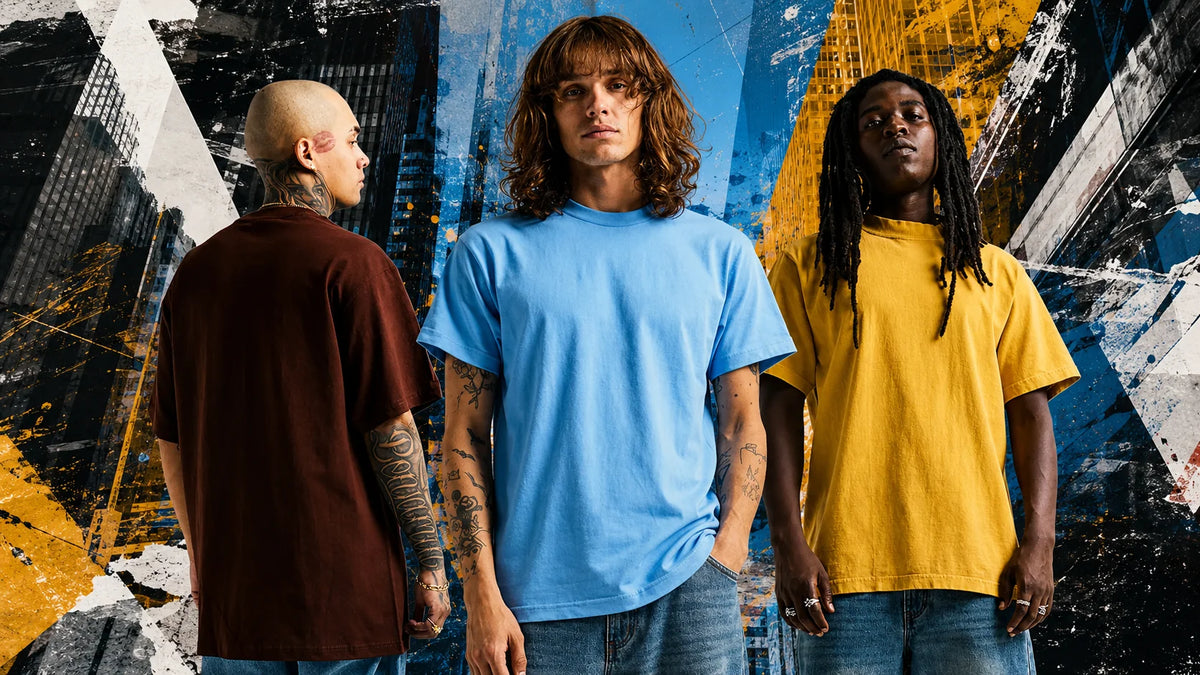
Shaka Wear offers several types of tees that can suit different creative directions. Home of Apparels currently carries options including a 6.0 oz Active Short Sleeve, a 7.5 oz Max Heavyweight Short Sleeve, and a 7.5 oz Max Heavyweight Garment Dye T-Shirt.
For more details about Home of Apparels
The important question is not simply which shirt is best, but which shirt makes the most sense for what you are creating.
Start With the Finished Garment in Mind
Before comparing colors, weights, or sizes, picture the finished piece.
Are you creating:
- Merchandise for an artist or music project?
- A streetwear release?
- Staff shirts for a business?
- Apparel for a community event?
- Branded merchandise for a creative agency?
- A small collection for a New York pop-up?
- Promotional shirts for a launch?
- Pieces with large front or back graphics?
The same blank will not necessarily be ideal for every one of these projects.
A fashion-oriented collection may benefit from a heavier shirt with a noticeable silhouette, while a promotional tee may need to feel lighter and easier to distribute across a large group. A detailed back graphic may also create different garment requirements than a small chest logo.
Starting with the intended result prevents you from choosing a shirt simply because it happens to be popular.
Explore Wholesale Hoodies in NYC
Understand What Fabric Weight Changes
One of the first specifications people notice when comparing blank tees is fabric weight.
But weight is not only a technical number.
It changes the personality of the shirt.
Lighter or midweight blanks
A lighter shirt generally feels less substantial and tends to drape more naturally around the body. Depending on the project, this can work well for everyday branded apparel, events, workwear, promotional merchandise, or designs where a relaxed conventional T-shirt feel is preferred.
Heavyweight blanks
Heavier fabric tends to create more structure.
Instead of falling closely against the body, the shirt can hold its shape more visibly around the shoulders, sleeves, and torso. This can be particularly useful when the garment itself is supposed to contribute to the visual direction of the collection.
Rather than assuming heavier automatically means better, ask what type of silhouette fits your design.
You Might be Interested in: New Arrivals: Affordable & Wholesale Streetwear Outfits Deals
Fit Matters Just as Much as the Artwork
A graphic does not exist separately from the garment.
Imagine placing the exact same design on two shirts: one narrow and lightweight, the other wider and more structured.
The artwork may be identical, but the finished products can feel completely different.
That is why anyone developing apparel should look beyond the front product photo and think about:
- Body width
- Shirt length
- Sleeve shape
- Shoulder position
- Overall proportions
- How the shirt looks one size up or down
- How much blank space surrounds the artwork
For a streetwear-inspired project, proportion may be part of the design itself. For uniforms or promotional apparel, predictable sizing may matter more.
Whenever possible, evaluate an actual sample before committing to a large run.
Best Selections of Men Collections
Match the Blank to the Size of Your Graphic
Printing a small left-chest mark and creating an oversized back graphic are very different projects.
A small logo requires relatively little printable space. A large illustration, photographic treatment, or typography-based design needs enough fabric around it to look intentional.
Consider where the artwork will sit:
Small chest graphics
These usually work across many blank styles because the print occupies limited space.
Large front graphics
These benefit from carefully checking the relationship between the design width and the dimensions of each shirt size.
Oversized back prints
A wider or more substantial garment can give the artwork more visual room.
Sleeve graphics
Sleeve shape and construction become more important when artwork extends beyond the torso.
Front-and-back designs
Fabric weight matters because multiple large print areas can noticeably change how the finished garment feels.
Do not select a shirt and then force your artwork to fit it. Treat the garment and design as one product.
Think About the Printing Method Before Ordering
Different decoration methods create different results, so the blank should be selected with the production process in mind.
Common methods used for custom apparel include:
- Screen printing
- DTF transfers
- Heat-applied graphics
- Embroidery for smaller placements
- Specialty inks and effects
For example, a bold graphic intended to sit prominently on top of a dense fabric may require a different production approach than a soft, subtle print.
The number of colors, size of the artwork, ink coverage, texture, and placement can all affect the result.
Home of Apparels also identifies DTF printing among its custom apparel services.
If you are working with a printer, discussing the blank before production begins is far easier than discovering compatibility problems after dozens of shirts have already been ordered.
Garment-Dyed Tees Create a Different Visual Direction
Garment-dyed shirts deserve separate consideration.
Instead of looking identical to a conventional solid-color blank, garment-dyed pieces can have a softer, more lived-in visual character. That can complement collections built around vintage influences, washed colors, understated graphics, or intentionally relaxed styling.
For designers, the distinction is important because the shirt color becomes part of the artwork.
A bright graphic on black may communicate something very different when the same artwork is placed on a muted garment-dyed shade.
When evaluating colors, view the complete combination:
shirt color + ink color + artwork + fit
-not each component independently.
Order Samples Before Building a Larger Run
Digital product images are useful, but they cannot tell you everything about a blank.
A physical sample helps you evaluate details such as:
- How dense the cotton feels
- How the collar sits
- The actual proportions
- Sleeve length
- Fabric texture
- Color in natural lighting
- Print placement
- How the garment behaves after washing
For a new clothing line, sampling becomes even more valuable.
Print one or several test garments and look at them the way a customer would. Wear them. Photograph them. Wash them. Style them with the rest of the collection.
Something that looked perfect on a design mockup may feel too large, too small, too high, or too low once printed on an actual shirt.
Testing early is much cheaper than correcting an entire production run.
Plan Your Size Mix Carefully
One common ordering mistake has very little to do with printing: buying the wrong quantity of each size.
Ordering exactly the same number of small, medium, large, XL, and larger sizes may seem organized, but real demand is rarely distributed evenly.
For established brands, previous sales should guide the size breakdown.
New projects can use a smaller first run to learn what customers actually purchase before committing to larger quantities.
NYC audiences can also vary significantly depending on the project. Merchandise created for a fashion pop-up may require a different size distribution from shirts created for a company, school event, restaurant team, or community organization.
If the garment is intentionally oversized, communicate that clearly as well. Customers may otherwise size up unnecessarily.
Keep Future Reorders in Mind
A blank should work not only for the first print run but also for the second, third, and fourth.
Imagine launching a design, selling through several sizes, and discovering that your replacement blanks are difficult to obtain. Even if you find a substitute shirt, differences in fabric, color, weight, or proportions can make the next batch noticeably different.
Consistency matters especially when a design becomes part of a permanent collection.
Before committing to a blank, consider:
- Will you probably reorder it?
- Are multiple sizes important?
- Are you building a core collection or a one-time release?
- Would changing the garment later affect your brand presentation?
- Do you need the same color across repeated production runs?
Home of Apparels is based in New York City and carries blank apparel for both wholesale and retail customers, including businesses, designers, retailers, and developing clothing brands.
For local apparel projects, having a reliable source for repeat orders can therefore be just as important as finding the initial blank.
Consider How the Shirt Will Be Worn
Custom apparel does not end when it comes off the printing press.
Someone eventually has to wear it.
Think about the environment in which the finished shirt will actually be used.
A heavyweight tee intended for a streetwear collection may be styled with loose denim, cargos, jackets, or layered pieces. A company shirt may be worn throughout an entire workday. An event shirt may need to work comfortably for staff moving around for hours.
Ask practical questions:
Does the shirt still make sense without the graphic?
Would the customer want to wear it repeatedly?
Does the silhouette match the identity of the project?
Does the fabric weight suit the intended use?
The strongest custom apparel often succeeds because the underlying garment is desirable before any artwork is added.
Avoid Choosing a Blank Only by Price
Cost matters, particularly when purchasing larger quantities.
But the lowest garment price does not automatically create the lowest overall project cost.
Consider what happens if an inexpensive blank does not match your design direction. You may spend money printing hundreds of shirts only to end up with merchandise that does not feel the way you intended.
Instead of focusing only on unit price, compare the full value of the blank:
- Fabric
- Construction
- Fit
- Print suitability
- Appearance
- Availability
- Size range
- Intended audience
- Potential for repeat use
Spending slightly more on the right garment may make much more sense than saving on a shirt that weakens the finished product.
Choosing Between Shaka Wear Options
There is no universal Shaka Wear tee for every printing project.
A useful way to narrow the choice is to think in terms of the final objective.
Consider a 6.0 oz option when:
You want a substantial everyday blank without necessarily moving into the heaviest possible silhouette.
Consider a 7.5 oz heavyweight tee when:
Structure, visual weight, and a stronger streetwear presence are important parts of the finished garment.
Consider a garment-dyed heavyweight tee when:
The shirt color and washed character are intended to contribute to the overall creative direction.
These are starting points rather than rigid rules. Your artwork, printing method, customer, sizing strategy, and budget should make the final decision.
Why Blank Selection Matters for NYC Apparel Projects
New York has no shortage of apparel ideas.
A tee might begin as artwork on a laptop in Queens, merchandise for a Brooklyn event, uniforms for a Manhattan business, or the first release from an independent clothing label.
Regardless of the project size, the blank creates the foundation.
Good artwork cannot completely compensate for a garment that feels wrong for the concept. When fabric, fit, color, printing, and design all support the same idea, however, the final shirt feels intentional rather than simply decorated.
That is why choosing blank T-shirts deserves more attention than scrolling through colors and clicking “add to cart.”
Final Thoughts
Choosing a blank T-shirt is really a design decision.
Fabric weight determines structure. Fit changes proportion. Color influences the artwork. Construction affects how the finished piece feels, and availability matters when successful designs need to be produced again.
For a New York clothing brand, business, print project, event, or creative release, Shaka Wear provides several blank options worth comparing rather than treating every tee as interchangeable.
Start with the purpose of the finished garment. Compare weights and fits. Test your artwork on a sample. Check sizing carefully. Then choose the blank that supports the product you actually want people to wear.
That process creates a much stronger foundation for custom apparel than choosing a shirt based on popularity alone.
Frequently Asked Questions
Are heavyweight T-shirts good for custom printing?
They can be. Heavyweight tees provide a substantial surface and a structured finished appearance, making them particularly suitable for projects where the garment itself contributes to the visual style. The best choice still depends on the artwork and printing process.
Is a heavier shirt always better?
No. Heavier describes fabric weight, not universal quality. Some projects benefit from substantial fabric, while others work better with a lighter or more conventional tee.
Should I print a sample before placing a large order?
For a new design, blank, or print method, producing a sample is one of the safest decisions you can make. It allows you to evaluate print size, placement, garment color, fit, and overall appearance before committing to a larger quantity.
What color blank is best for printing?
There is no single best color. Choose the garment color alongside the artwork rather than separately. Contrast, ink colors, collection palette, and intended mood should all be considered.
How do I choose between a 6.0 oz and 7.5 oz tee?
Think about the silhouette and wearing experience you want. A 7.5 oz shirt generally creates a more substantial feel, while a 6.0 oz option can provide a different balance between structure and everyday wearability. Compare physical samples whenever possible.