

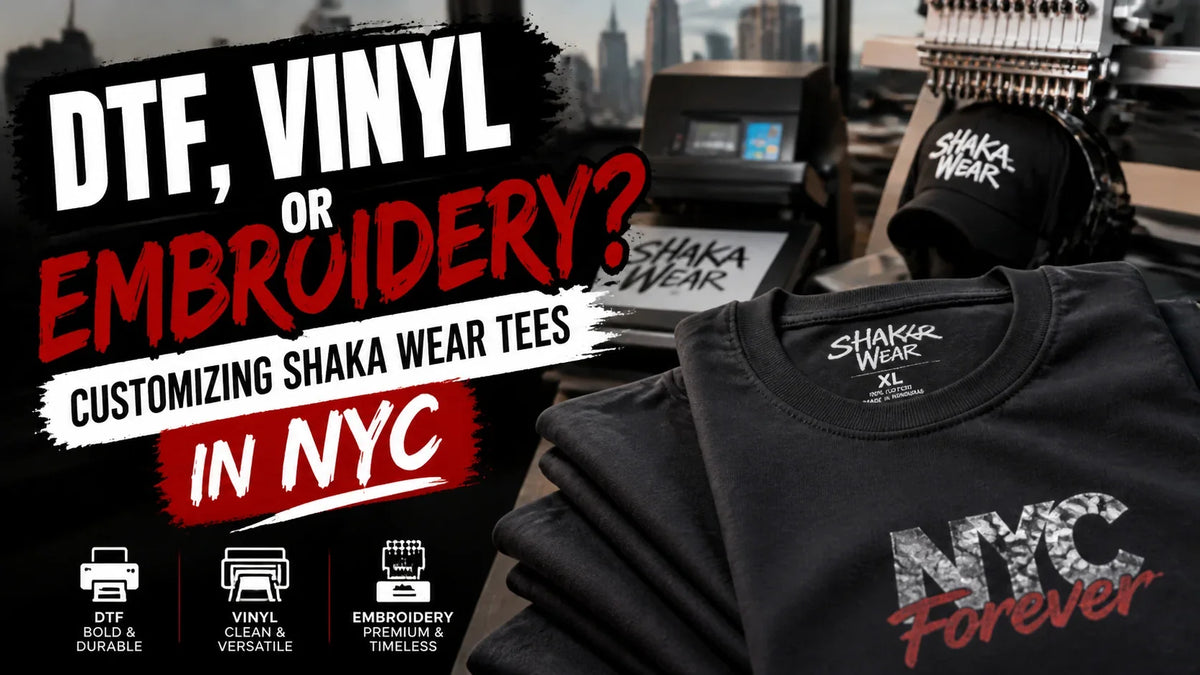
DTF, Vinyl or Embroidery? Customizing Shaka Wear Tees in NYC
Choosing a blank T-shirt is only half the job. Once you've picked the garment, the next question is how to turn it into something people actually want to wear.
That could mean a bold back graphic, a small embroidered logo, a simple chest print, or a detailed illustration across the front. The decoration method you choose can change the appearance, texture, and overall character of the finished garment.
For anyone working with shaka wear tees, the choice is particularly interesting. Their heavier, streetwear-inspired feel gives you a strong foundation for graphics, branding, and custom apparel.
But should you use DTF, vinyl, or embroidery?
The answer depends on your design, the garment, and what you want the finished piece to look and feel like.
For more details about Home of Apparels
What Is DTF Printing and Why Is It Popular for Custom Apparel?
If you've been researching custom clothing, you have probably come across the question, what is dtf printing?
DTF stands for Direct-to-Film. In simple terms, the artwork is printed onto a special transfer film and then applied to the garment using heat.
The appeal is flexibility.
A design can contain multiple colors, fine details, gradients, illustrations, and other elements that would be difficult to reproduce with some simpler decoration methods.
That makes DTF particularly useful when you're working on a custom t shirt design that is more complicated than a basic logo.
Imagine a graphic featuring a detailed city illustration, several colors, shadows, and small lettering. You don't want to simplify the artwork just because the printing process can't handle it.
That's one situation where DTF can be a practical choice.
Learn about Choosing Shaka Wear Blank T-Shirts for Custom Printing in NYC
When Does Vinyl Printing Make More Sense?
Not every design needs a full-color transfer.
Sometimes the best design is incredibly simple.
- A name.
- A number.
- A short phrase.
- A one-color logo.
That's where vinyl printing can be useful.
Vinyl is cut into the desired shape and then heat-applied to the garment. Because the process works particularly well with bold shapes and lettering, it can be a good fit for team apparel, personalized shirts, uniforms, and straightforward branding.
For example, imagine a group ordering shirts with the same team logo on the front and individual numbers on the back. There's no need to make the artwork unnecessarily complicated.
Vinyl can provide a clean, direct result.
Could Embroidery Give Your Shirt a More Premium Look?
Embroidery creates an entirely different appearance.
Instead of printing a design onto the garment, thread is stitched into the fabric. You can see the individual stitches, and the finished design has texture and dimension.
A small embroidered logo on a heavyweight shirt can create a subtle and sophisticated look.
It can work particularly well for:
- Small brand logos
- Business apparel
- Uniforms
- Minimal designs
- Chest logos
- Premium branding
However, embroidery isn't necessarily the answer for every project.
Large designs can become heavy, and highly detailed artwork may need to be simplified so that it can be converted into stitches.
If your artwork is a large, colorful illustration, DTF will usually give you more freedom.
Are Shaka Wear Tees Good for Large Graphics?
What makes a heavyweight garment interesting is that it can support a stronger visual presence.
A lightweight promotional shirt may work well with a small logo, but a heavier streetwear-style garment can carry a large graphic without the shirt feeling visually overwhelmed.
That's one reason shaka wear tees are attractive for streetwear projects.
A large back print can become the focal point of the garment, while a smaller chest mark can keep the front clean.
If you're building a collection, you don't necessarily have to use the same decoration method on every shirt. One design might work best as a large DTF graphic, while another could look better with a small embroidered logo.
What Makes a Heavyweight Tee Different From an Ordinary T-Shirt?
A heavyweight tee has a different feel from a lightweight everyday shirt.
The fabric tends to feel more substantial, and the garment can have a more structured appearance.
That difference matters when you're choosing artwork.
A large, detailed graphic can complement a heavier shirt particularly well because the garment itself has enough visual weight to support it.
This is also why heavyweight graphic tees have become popular with customers looking for a more substantial streetwear aesthetic.
The graphic and the blank work together. You aren't simply printing an image onto fabric; you're creating a complete garment.
You might be interested in Best Cotton T Shirts for Men & Oversized T Shirts Online
Should You Choose a Black T-Shirt for Your Design?
A black t shirt and a bright graphic can create a very different result from the same artwork on a white or light-colored garment.
Black gives colorful artwork strong contrast and can make bright colors appear more dramatic.
But there's an important consideration: not every design needs maximum contrast.
Sometimes a dark gray print on black can create a much more understated look. A small tonal logo can feel completely different from a large, bright graphic.
So before deciding on the garment color, think about the mood you're trying to create.
“Do you want the artwork to immediately grab attention?
Or should someone notice the design only after looking twice?”
Both approaches can work.
Does the Type of Shirt Change the Decoration Method?
It can. People often think only about the artwork, but the garment itself matters just as much.
For example, short sleeve t-shirts are the obvious choice for many graphic projects because they provide plenty of space across the chest and back while remaining versatile throughout the year.
But what if you want something different?
Long sleeve shirts give you additional areas to work with. You can put a graphic on the chest, add artwork to the back, or use the sleeves as part of the design.
That creates opportunities that simply aren't available with a standard short-sleeve garment.
Could Long Sleeves Make Your Design More Interesting?
Absolutely. A long sleeve tshirt can become a much more interesting canvas when the sleeve itself is part of the design.
For example, you could keep the chest minimal and place typography or graphics down one sleeve.
For a streetwear collection, that can create a stronger sense of identity without putting a huge image on the front.
A clothing long sleeve t shirt can also work well for brands that want a more layered or seasonal appearance.
Instead of treating the sleeve as empty space, think of it as another part of the design.
Explore: Long Sleeve T-Shirts
When Are Short Sleeve Men's T-Shirts the Better Choice?
For everyday wear, short sleeves remain one of the easiest options.
Short sleeve mens t shirts are versatile, easy to layer, and suitable for everything from casual clothing to branded merchandise.
They're also a natural starting point for businesses and clothing brands because the front and back provide straightforward printing areas.
If your goal is a classic graphic T-shirt, a short-sleeve heavyweight blank may be all you need.
But if you're trying to create something more distinctive, experimenting with sleeves, placement, and garment weight can help separate your apparel from generic promotional clothing.
How Should You Approach a Custom T-Shirt Design?
The biggest mistake is starting with the printing method instead of the idea.
Start with the design.
Ask:
What should people notice first?
Is it the artwork?
The brand name?
The message?
The shirt itself?
Once you know that, decide how large the design needs to be and where it should go.
- A simple chest logo might only need a small print.
- A streetwear illustration might deserve the entire back.
- A typography-focused design might look better running vertically down a sleeve.
Good custom t-shirt printing begins with those decisions before the shirt ever reaches the press.
Does Artwork Size Matter When Choosing DTF, Vinyl, or Embroidery?
It matters a lot.
- A small logo can work beautifully with embroidery.
- A medium-sized, simple graphic may be ideal for vinyl.
- A large, detailed illustration may be better suited to DTF.
The bigger the design becomes, the more important the choice of decoration method becomes.
You also need to consider how the artwork interacts with the shape of the garment.
A graphic that looks perfect in a square digital mockup may look too small on a large shirt or too large once it's actually printed.
Whenever possible, look at the design at its actual intended size before production.
Should You Test Your Design Before Ordering in Bulk?
If you're producing apparel for a brand, absolutely.
A digital mockup can tell you what the design is supposed to look like.
A physical sample tells you what it actually looks like.
Those are two very different things.
Order a sample and look at:
- The print size
- Color accuracy
- Placement
- Fabric feel
- Overall fit
- Print texture
- How the garment looks after washing
This is particularly important when you're producing custom t-shirt printing for a clothing brand. A small sample cost can prevent a much larger production mistake.
Which Decoration Method Is Best for Streetwear?
There isn't one universal answer.
If you're creating colorful artwork with lots of detail, DTF can provide the flexibility you need.
If you're creating bold lettering or simple numbers, vinyl can be a straightforward solution.
If your brand identity is minimal and you want a textured logo, embroidery may be the better choice.
The best method is the one that supports the visual identity of the garment.
A heavyweight blank with a huge colorful back graphic communicates something very different from a heavyweight blank with a tiny embroidered chest logo.
Neither is automatically better.
They're simply different.
Can You Use These Methods on Other Blank Apparel?
Definitely. The same thinking applies beyond T-shirts.
At Home of Apparels, customers can explore different blank garments for brands, businesses, teams, events, and retail projects.
That includes T-shirts, hoodies, sweat sets, sweat suits, jackets, shorts, bags, and other apparel.
The important thing is to match the decoration method to the garment.
A technique that works beautifully on a T-shirt may need to be approached differently on a hoodie, jacket, or other heavier garment.
How Does Home of Apparels Help With Custom Apparel in NYC?

Home of Apparels provides blank apparel for customers in New York City who are developing clothing brands, ordering merchandise, outfitting teams, preparing event apparel, or sourcing garments for resale.
The selection includes Shaka Wear and other everyday apparel options, while custom DTF services are available for customers who want finished printed garments.
The goal isn't to push everyone toward one decoration method.
It's to help customers start with the right garment and then choose a customization approach that makes sense for the project.
Whether you're developing a small collection or ordering apparel for an organization, the finished garment should feel intentional from the blank fabric to the final graphic.
So, Should You Choose DTF, Vinyl, or Embroidery?
If your design is detailed and colorful, DTF is worth considering.
If you're working with simple lettering, numbers, or bold shapes, vinyl may be enough.
If you want a small design with texture and dimension, embroidery can create a distinctive result.
But don't choose a method simply because someone says it's the "best."
- Think about your artwork.
- Think about the garment.
- Think about how people will wear it.
And most importantly, think about what you want the finished product to feel like.
A good custom shirt isn't just a blank garment with something printed on it. The fit, fabric, artwork, placement, and decoration method should all make sense together.
That's what turns an ordinary blank into something people actually want to wear.
Frequently Asked Questions
Which customization method is best for Shaka Wear tees?
It depends on the artwork. DTF is useful for detailed and multi-color graphics, vinyl suits simpler lettering and shapes, while embroidery works well for smaller logos and textured branding.
Is DTF good for large back graphics?
Yes. DTF can be a practical option when a large back design includes multiple colors, illustrations or detailed artwork.
When should I choose vinyl?
Vinyl is worth considering for names, numbers, simple logos, short phrases and bold typography.
Can heavyweight tees be embroidered?
Yes, depending on the garment and artwork. Smaller logos and simple designs are generally better suited to embroidery than highly detailed, oversized graphics.
What works best for a small chest logo?
Embroidery can create a clean, textured finish. DTF or vinyl may also work depending on the amount of detail and the appearance you want.
Can clothing brands use more than one decoration method?
Yes. Different pieces can use DTF, vinyl or embroidery while still maintaining a consistent collection through the garment style, artwork, colors and overall branding.
Do oversized tees need larger artwork?
Often they do. Wider garments can make standard artwork dimensions appear smaller, so the design should be sized according to the actual shirt.
Where can I customize blank tees in NYC?
Home of Apparels serves wholesale and retail apparel customers in New York City and supports custom apparel projects using DTF, vinyl and embroidery.